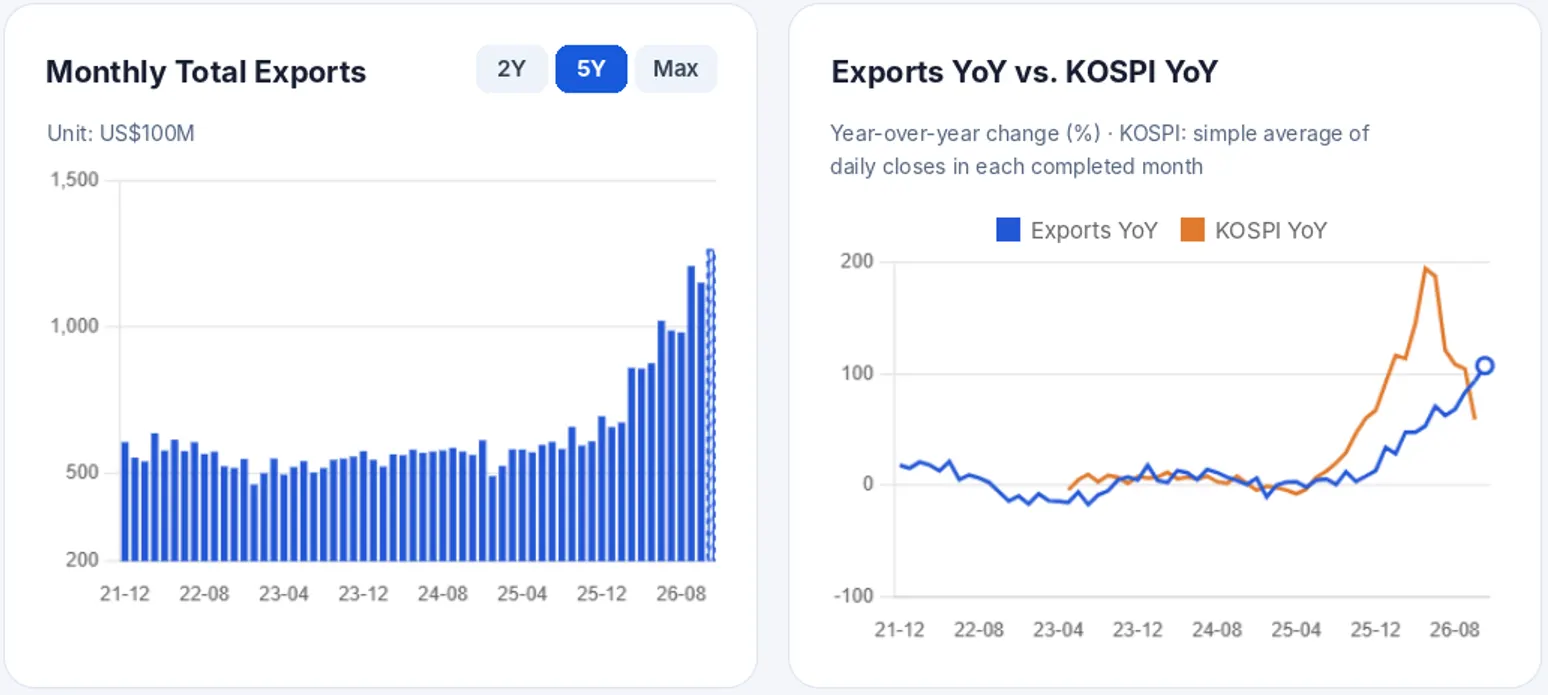
Korea's exports continue to grow at a remarkable pace. Monthly exports have surpassed $100 billion this year, with year-over-year growth exceeding 100%. (November figures are estimates, as the month is still in progress.)
Yet the KOSPI's year-over-year gain, which once surged to nearly 190%, has rapidly cooled to around 60%. This marks a striking reversal from 2023 through 2025, when export growth and the stock market largely moved in tandem.
The Reality Behind Export Growth: Semiconductors Are Doing All the Heavy Lifting
As discussed in the previous analysis, nearly all of the recent increase in exports has come from semiconductors. Non-semiconductor exports, by contrast, have remained largely flat for two years.
At first glance, the headline export figures suggest a broad-based boom across the Korean economy. In reality, however, only a handful of industries are generating meaningful incremental growth.
The KOSPI Is Also Divided: Samsung and SK Hynix vs. Everyone Else
The same concentration is evident in the stock market.
With earnings growth largely concentrated in the semiconductor sector, the KOSPI's rally has been driven primarily by Samsung Electronics and SK Hynix. Returns across most other sectors have lagged far behind the benchmark.
This helps explain why many investors feel that their portfolios have not risen nearly as much as the headline index suggests.
Even the Market's Last Pillars Are Starting to Wobble
The bigger concern is that even Samsung Electronics and SK Hynix, the two stocks that have powered the index higher, have recently come under pressure.
Several factors have converged: foreign investors taking profits, concerns about the financial burden of expanding AI investment, and persistent interest rate pressures.
As the two stocks that had been holding up the index began to lose momentum, the disconnect became increasingly pronounced: Korean exports continued to hit record highs, while the KOSPI started to lose ground.
What Should Investors Watch From Here?
Export data remains strong. But the more important question is no longer simply how much more semiconductor companies can earn. It is how long this boom can last, and whether its benefits will eventually spread beyond the semiconductor sector.
It is also worth noting that the slowdown in the KOSPI's year-over-year gain partly reflects a high base of comparison following the sharp rally around the same time last year. Therefore, it would be premature to interpret the recent slowdown as a definitive trend reversal.
For the gap between exports and the stock market to narrow, one of two things needs to happen:
1. Concerns surrounding semiconductor market dynamics, including supply-demand conditions and financial pressures, need to ease.
2. Export growth needs to broaden beyond semiconductors, with other industries beginning to contribute meaningfully.