
Semiconductor Exports Now Account for More Than Half of South Korea's Total Exports
Semiconductors now account for more than 53% of South Korea's total exports. (November figures are estimates, as the month is still in progress.)
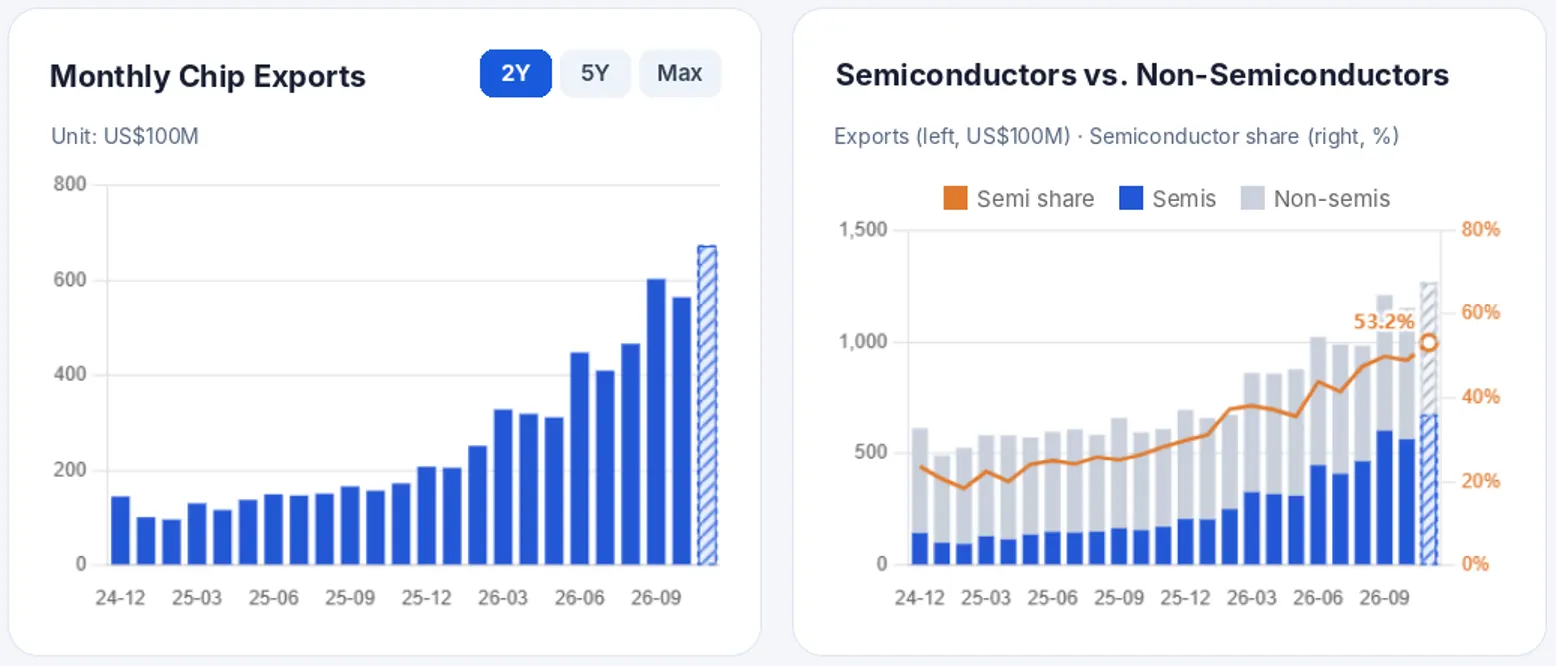
Just two years ago, in December 2024, semiconductors accounted for only a little over 20% of total exports. Monthly semiconductor exports have also surged from around $15 billion to nearly $60 billion, almost quadrupling in the process.
Even at the peak of the 2018 memory supercycle, semiconductors accounted for only a little over 20% of annual exports. The current environment is therefore on an entirely different scale.
But there is another detail worth paying attention to in the second chart: the gray bars, which represent non-semiconductor exports.
Over the past two years, non-semiconductor exports have remained largely unchanged at around $50–60 billion per month. In other words, semiconductors have been doing almost all the heavy lifting behind Korea's export growth.
Could the Semiconductor Share Reach 60% or Even 70%?
How much higher could this share go?
Assuming non-semiconductor exports remain flat at around $60 billion per month:
- For semiconductors to account for 60% of total exports, monthly semiconductor exports would need to reach approximately $90 billion.
- For the share to reach 70%, monthly semiconductor exports would need to climb to approximately $140 billion.
At the current pace of growth, a semiconductor share in the 60% range appears increasingly within reach.
Beyond that, however, further gains would be difficult to achieve through higher export volumes alone. Continued increases in memory prices would likely be necessary.
Semiconductor Dollars: A Major Economic Boost, but Also a Growing Vulnerability
The dollars generated by semiconductor exports support South Korea's trade balance and help underpin the won. They also flow through to the earnings of Samsung Electronics and SK Hynix, contributing to corporate tax revenues and supporting the KOSPI.
Semiconductors have effectively become one of the main engines of the Korean economy.
But a semiconductor share above 50% also means that more of the economy's eggs are sitting in a single basket.
A significant portion of the recent export growth has been driven by higher prices rather than volume alone. If memory prices reverse course, the impact could extend well beyond chipmakers and weigh on South Korea's overall export performance.
The Key Metrics to Watch: Semiconductor Share and Non-Semiconductor Growth
The critical question is whether other industries can catch up while semiconductors continue to lead, or whether South Korea's dependence on the semiconductor sector will deepen further.
Going forward, two figures deserve particular attention in Korea's export data: the semiconductor share of total exports and the growth rate of non-semiconductor exports.
There is another interesting development worth noting: while exports continue to hit record highs, the stock market is showing signs of losing momentum.
In the next analysis, we will take a closer look at the widening disconnect between South Korea's export performance and the KOSPI.